
- Home
- About Us
-
Products
- National Zero Till Seed Cum
Ferti Drill - National Zero Till Happy Seeder
- National Zero Till Multi Crop
Planter for 2 Wheel Tractor
(Direct Hitch/Power Tiller) - National Direct Seeder for
Rice (Multi Crop) - National Seed Cum Fertilizer Drill
- National Multi Crop Planter
- National Multi Crop Planter for
Mini Power Tiller - National Multi Crop Ridge Planter
- National Raised Bed Planter
- National Pneumatic Planter
- National Fertilizer Spreader
- National Vegitable Nursery
Transplanter - National Axil Flow Vegetable
Seed Extractor - National Grond Nut Digger
- National Post Hole Digger
- National Maize Sheller
No-Tillage Equipment
Tillage Equipment
Ridge Planter Equipment
Bed Planter Equipment
Precision Planter Equipment
Fertilizer & Nursery Equipment
Specialized Seed Extractors
& Vegetable Equipme
Urea Deep Placement
- National Zero Till Seed Cum
- Blogs
- Awards
- Career
- Gallery
Contact Us
Become a Dealer
Become a Vendor
Conventional vs Minimum vs Zero Tillage Compared
14, August, 2026
Conventional vs Minimum vs Zero Tillage Compared
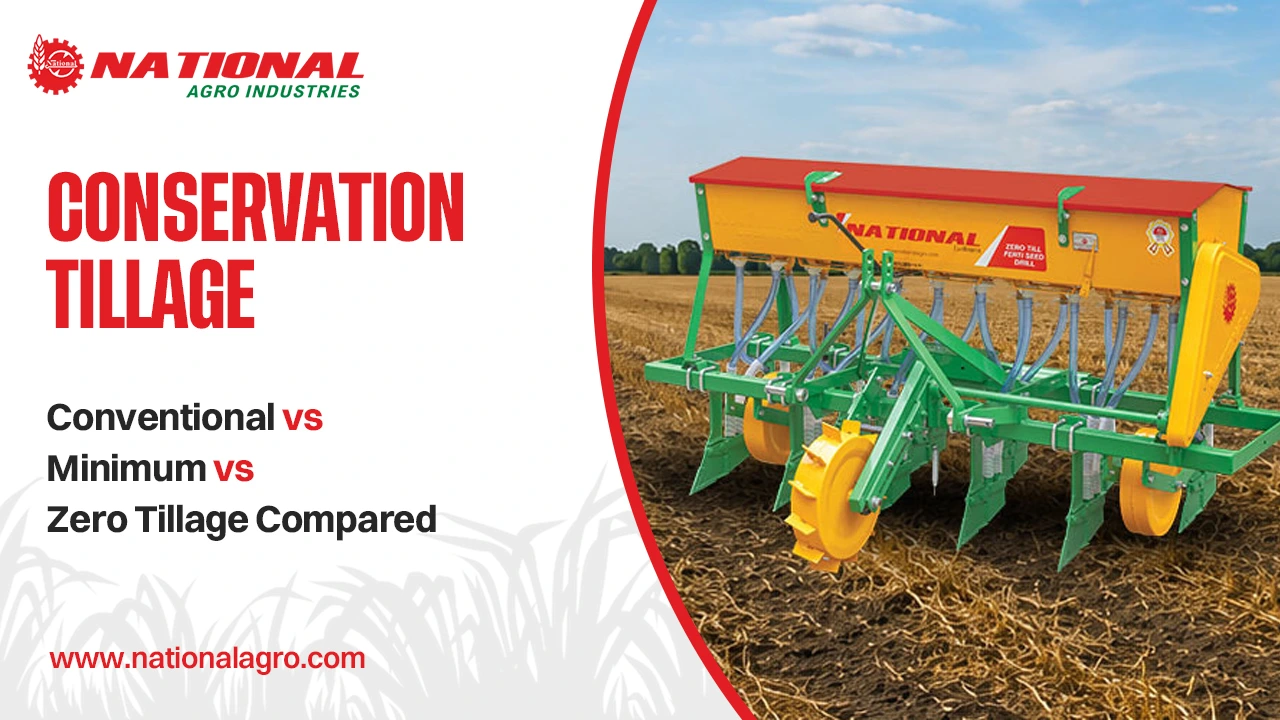
Conservation tillage refers to any method of land preparation that reduces how much the soil is disturbed before sowing, cutting down on erosion, moisture loss, and fuel use compared to full conventional ploughing. Under this umbrella sit two main approaches, minimum tillage and zero tillage, each disturbing the soil less than the last. Which one makes sense for your field depends on your soil type, your crop rotation, and honestly, how much you're tired of paying for diesel.
Here's how the three main approaches actually compare, with real numbers from research done right here in Punjab and Haryana.
Ploughing vs Tilling — Are They the Same Thing?
Short answer: not quite, though the terms get used interchangeably in everyday farm conversation.
Ploughing specifically refers to turning over the top layer of soil, usually with a mouldboard or disc plough, to break up compacted earth and bury crop residue. It's considered primary tillage, the first and deepest pass on a field.
Tilling is the broader term. It covers the entire process of preparing soil for sowing, which can include ploughing as the first step, followed by secondary operations like harrowing, planking, or cultivating to break clods and level the seedbed.
So every ploughing operation is a form of tilling, but not every tilling operation involves a plough. When farmers talk about "primary tillage implements," they're usually referring to the heavier machinery like mouldboard ploughs, disc ploughs, and chisel ploughs that do the first deep pass. Secondary tillage implements, like cultivators and harrows, come in after that to refine the seedbed.
Conventional Tillage — Pros, Cons, and Real Cost Per Acre
Conventional tillage is what most Indian farmers grew up watching their fathers do. It typically involves two to four passes, starting with deep ploughing, followed by disc harrowing, planking, and sometimes a cultivator pass, before the field is finally ready for sowing.
What it does well:
- Breaks up compacted soil and buried residue effectively
- Controls weeds mechanically, reducing herbicide dependency in some systems
- Works reliably across a wide range of soil types
- Familiar process with widely available implements and skilled operators
Where it falls short:
- Multiple passes mean multiple rounds of diesel, labor, and machine wear
- Delays sowing, which is a real problem in rice-wheat systems where timely wheat planting after paddy harvest directly affects yield
- Increases soil moisture loss through repeated exposure and evaporation
- Leaves soil more vulnerable to wind and water erosion between seasons
On cost, conventional tillage in Punjab and Haryana typically runs higher than either reduced-tillage alternative, largely due to the sheer number of tractor passes required. Diesel, tractor time, and labor for two to four operations add up fast, and that's before accounting for the yield hit that often comes from delayed sowing after rice harvest.
Minimum Tillage — The Middle Ground Nobody Explains Well
Minimum tillage sits between the two extremes, and it's genuinely underexplained in most farming content, which is a shame because it fits a lot of real-world situations well.
Instead of the full conventional sequence, minimum tillage typically involves just one or two passes, often a single cultivator or disc pass followed directly by sowing, skipping the deep ploughing step entirely. The idea is to disturb the soil enough to manage residue and create a workable seedbed, without the time and fuel cost of a full conventional sequence.
This approach tends to suit medium to firm soils with moderate crop residue, where a single pass is enough to prepare a decent seedbed but the ground isn't compacted enough to need deep ploughing. It's a practical entry point for farmers who want to reduce fuel and labor costs but aren't ready to commit fully to zero-till, whether due to soil type, equipment access, or simply wanting to see results before going all in.
Minimum tillage won't deliver the full moisture and erosion benefits of zero-till, but it cuts tillage costs meaningfully compared to the conventional route, while still giving the soil a light working-over that some farmers feel more comfortable with, especially in the first few seasons of transitioning away from full conventional tillage.
Zero/No-Till — Why It's Gaining Ground in Punjab & Haryana
Zero tillage skips soil preparation entirely. Seeds and fertilizer go directly into unploughed soil, often straight into standing rice stubble, using a seed drill designed for the job. No ploughing, no harrowing, no planking.
This isn't a new idea in this region. India's rice-wheat belt has been at the center of zero-till adoption since the 1990s, largely because the technology solved a very specific regional problem: getting wheat sown quickly enough after rice harvest to avoid yield-damaging delays. National Agro developed South Asia's first Zero Till Ferti Seed Drill back in 1993, right here in Ludhiana, and the technology has only gotten more refined since.
The appeal for Punjab and Haryana farmers specifically comes down to a few compounding factors. Rice harvest and wheat sowing windows are tight, and every day of delay in sowing wheat tends to cost yield. Zero-till lets farmers sow within days of rice harvest instead of waiting for the field to be cleared, ploughed, and prepared. It also handles rice stubble directly, which matters enormously given how much attention stubble burning has drawn from both regulators and the courts in recent years. Sowing straight into standing or shredded stubble with a Happy Seeder or zero-till drill removes the pressure to burn residue just to clear the field in time.
Fuel and Labor Savings, With Numbers
This is where zero-till makes its strongest case, and the research backs it up consistently.
Research from Punjab Agricultural University has found that zero tillage can cut diesel use for wheat sowing by 60 to 70 percent compared to the conventional route, since you're eliminating multiple tractor passes entirely. A more recent study covering Happy Seeder adopters across Punjab and Haryana measured an average fuel saving of roughly 13 litres per hectare during the wheat season, working out to a direct fuel cost saving of around Rs 1,600 per hectare.
On overall cost of cultivation, the numbers vary by study and season, but they point the same direction. Early PAU-linked estimates put the tillage cost saving from zero-till at roughly Rs 600 to Rs 800 per acre. A more recent economic study out of Haryana recorded a wheat cultivation cost reduction of around Rs 7,000 per hectare under zero-till, alongside a yield increase of close to 6 quintals per hectare, largely credited to timelier sowing.
Labor drops too, since you're cutting out two or three tractor operations per field. Less tractor time also means less wear on machinery over a season, which is a cost that rarely gets talked about but adds up over the years.
Side-by-Side Comparison Table
|
Factor |
Conventional Tillage |
Minimum Tillage |
Zero Tillage |
|
Number of passes |
2 to 4 |
1 to 2 |
0 (direct sowing) |
|
Relative cost per acre |
Highest |
Moderate |
Lowest |
|
Diesel use |
Highest |
Reduced |
Cut by roughly 60–70% |
|
Sowing speed after rice harvest |
Slowest |
Faster |
Fastest |
|
Soil moisture retention |
Lowest |
Moderate |
Highest |
|
Erosion risk |
Higher |
Moderate |
Lowest |
|
Residue/stubble handling |
Requires clearing or burning |
Partial handling |
Sows directly into stubble |
|
Best suited soils |
Compacted, uncultivated |
Medium to firm, moderate residue |
Undisturbed soils, heavy residue |
|
Learning curve |
Familiar to most farmers |
Low |
Moderate, new equipment and technique |
Which Tillage Tine Type Matches Your Soil?
The right seed drill and tine setup depends entirely on what condition your soil is in and how you're preparing it.
Conventional seeding tines work best on well-prepared, loose soil where tillage has already loosened the ground ahead of sowing.
Minimum tillage tines are built for medium to firm soils with moderate residue, striking a balance between soil disturbance and moisture retention.
No-tillage tines are designed specifically for undisturbed soil with heavy crop residue, allowing direct seeding into standing stubble without any prior land preparation, while preserving soil moisture and structure.
Tillage tines suit hard, compact, or previously uncultivated soil that needs deeper penetration to place seed properly.
If you're transitioning from conventional to reduced tillage, matching your drill's tine type to your actual field conditions makes a bigger difference to establishment success than almost any other equipment decision. Browse the full range of seed drills and planters to find the right fit for your soil and cropping system.
FAQs
Is zero tillage suitable for all soil types? Not universally, no. Zero-till performs best on soils that aren't severely compacted and where drainage is reasonably good. Very hard, uncultivated soils or fields with serious compaction issues usually need at least one season of deeper tillage or minimum tillage before zero-till can be sown into effectively.
Do I need a special seed drill for zero tillage? Yes. A standard seed drill isn't built to cut through unploughed soil or standing stubble. Zero-till drills, like a Happy Seeder or a zero-till ferti-seed drill, use specially designed tines and cutting mechanisms that can slice through residue and place seed at the right depth without prior land preparation.
Will switching to zero tillage reduce my yield? Generally not, and in a lot of documented cases across Punjab and Haryana, yield has actually increased under zero-till, mainly because farmers can sow wheat sooner after rice harvest instead of losing days to land preparation. The main risk to yield comes from poor seed-soil contact if the drill or technique isn't suited to your field's residue and soil conditions.
Can I switch straight from conventional to zero tillage, or should I go through minimum tillage first? Both paths work, and plenty of farmers jump straight to zero-till successfully. That said, if your soil has been under heavy conventional tillage for years and is quite compacted, a season or two of minimum tillage can ease the transition and give the soil structure time to adjust before committing fully.
Ready to Cut Your Tillage Costs?
A few things worth remembering before you decide:
- Conventional tillage costs the most in fuel, labor, and time, mainly due to multiple tractor passes
- Minimum tillage is a practical middle step, cutting costs without a full equipment or technique overhaul
- Zero tillage delivers the biggest savings on diesel and labor, with research showing 60 to 70 percent lower fuel use and real cost reductions per acre
- Matching your seed drill's tine type to your actual soil condition matters as much as the tillage method itself
If you're ready to make the switch, explore the National Zero Till Seed Cum Ferti Drill for direct sowing into unploughed fields, or the National Seed Cum Fertilizer Drill if you're working with prepared soil and want precision seed and fertilizer placement in one pass.


QR Code