- Home
- About Us
-
Products
- National Zero Till Seed Cum
Ferti Drill - National Zero Till Happy Seeder
- National Zero Till Multi Crop
Planter for 2 Wheel Tractor
(Direct Hitch/Power Tiller) - National Direct Seeder for
Rice (Multi Crop) - National Seed Cum Fertilizer Drill
- National Multi Crop Planter
- National Multi Crop Planter for
Mini Power Tiller - National Multi Crop Ridge Planter
- National Raised Bed Planter
- National Pneumatic Planter
- National Fertilizer Spreader
- National Vegitable Nursery
Transplanter - National Axil Flow Vegetable
Seed Extractor - National Grond Nut Digger
- National Post Hole Digger
- National Maize Sheller
No-Tillage Equipment
Tillage Equipment
Ridge Planter Equipment
Bed Planter Equipment
Precision Planter Equipment
Fertilizer & Nursery Equipment
Specialized Seed Extractors
& Vegetable Equipme
Urea Deep Placement
- National Zero Till Seed Cum
- Blogs
- Awards
- Career
- Gallery
Contact Us
Become a Dealer
Become a Vendor
Father of Zero Tillage in India: History, Contributions & Impact
07, August, 2026
Father of Zero Tillage in India: History, Contributions & Impact
Ask most people who the father of zero tillage in India is, and you won't get a straight answer, because unlike the Green Revolution, which has Norman Borlaug's name stamped all over it, zero tillage in India doesn't trace back to one famous scientist. It traces back to a machine.
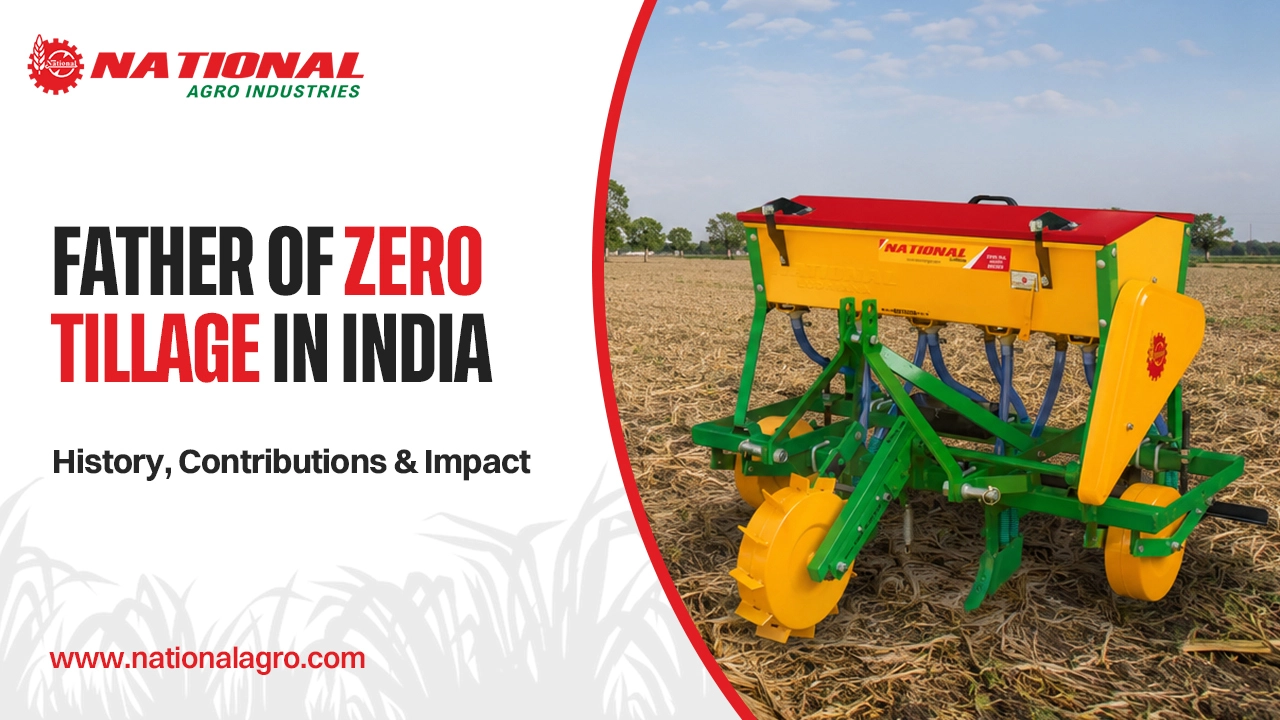
Specifically, it traces back to 1993, a workshop in Ludhiana, and South Asia's first Zero-Till Ferti Seed Drill, built by National Agro Industries with guidance from G.B. Pant University of Agriculture & Technology and later backed by Punjab Agricultural University, CIMMYT, and ICAR. That's the honest answer. Zero tillage in India has a birthplace and a machine behind it, even if it doesn't have one single face on a stamp.
If you're a farmer, an agri-student, or just someone trying to understand how Indian farming quietly changed direction over the last three decades, this is that story.
What Is Zero-Till (No-Till) Farming, in Simple Terms
Zero tillage means sowing the next crop directly into the field without ploughing, harrowing, or levelling it first. The seed and fertilizer go straight into the soil, stubble and all, in a single pass.
Compare that to the traditional method, where a farmer ploughs the field two or three times, levels it, waits for the soil to dry to the right moisture, then sows. That's several days of tractor work, several litres of diesel, and several passes of soil disturbance before a single seed goes in.
A zero till drill skips almost all of that. One pass, seed and fertilizer placed at the right depth, done. It sounds almost too simple, which is probably why it took Indian farmers a while to trust it.
India Before 1993, Why Every Farmer Still Ploughed
Before the early '90s, ploughing wasn't just tradition in Punjab and Haryana, it was considered the only way to do it properly. Farmers believed a field needed to be turned over and cleared before it could take a new crop, especially after rice harvest when the ground was full of leftover paddy stubble.
That belief came with real costs. Extra diesel for repeated tillage passes. Extra days between harvest and sowing, which pushed wheat sowing later than ideal and quietly cut into yields. And once combines started leaving more loose straw in the field, farmers leaned on the fastest fix available: burning it.
Nobody had a fast, reliable way to sow directly into that stubble yet. That gap is exactly what the next few years were about to close.
The Year Everything Changed: South Asia's First Zero-Till Ferti Seed Drill
In 1993, National Agro Industries, a Ludhiana-based manufacturer that had already been building seed-cum-fertilizer drills since the early '70s, developed what's recognized as South Asia's first Zero-Till (No-Till) Ferti Seed Drill.
This wasn't a lab prototype that stayed in a research paper. It was a working, tractor-mounted zero tillage machine, tested and approved by the Northern Region Farm Machinery Testing Center in Hissar, Punjab Agricultural University in Ludhiana, and G.B. Pant University in Pantnagar. It went from workshop to farmer's field with actual institutional backing behind it, which is a big part of why it stuck instead of fading out like a lot of promising farm-tech does.
How the Zero-Till Ferti Seed Drill Actually Worked
The design itself was fairly clever in how simple it kept things. Narrow, blade-type furrow openers cut through stubble and soil with minimal disturbance, so you weren't churning up the whole field, just opening a slim channel exactly where the seed needed to go.
Behind that, a seed and fertilizer hopper released both at a controlled rate through an adjustable metering system, so farmers could dial in exactly how much seed and fertilizer went down per acre. Depth control wheels kept placement consistent across the whole field instead of leaving patchy, uneven germination.
Put together, that meant one pass of the tractor could do what used to take three or four. Less diesel, less labour, and crucially, a field that could go from rice stubble straight to a sown wheat crop without burning anything first.
Why Punjab Agricultural University and CIMMYT Got Involved
A new machine showing up in a farmer's shed doesn't mean much on its own. What actually moved the needle was research institutions stepping in to validate and refine it.
Punjab Agricultural University had already been studying reduced tillage through the late '80s and early '90s, so when a working zero till drill appeared, PAU was positioned to test it seriously, not just endorse it on faith. CIMMYT, the International Maize and Wheat Improvement Center, brought decades of global no-till research from Latin America and other wheat-growing regions, plus a genuine interest in solving the rice-wheat system problem specific to the Indo-Gangetic Plains.
That combination, a working Indian-made machine plus serious agricultural science backing it, is really what separated this from being just another farm implement. ICAR and the Rice-Wheat Consortium later recognized National Agro Industries with an award specifically for its contribution to designing and developing zero till drills in India, which tells you the institutional world took this seriously too.
From One Machine to a National Movement
Once the zero tillage machine had institutional backing, the bigger problem it eventually helped tackle was stubble burning, one of North India's most stubborn environmental headaches. Punjab and Haryana farmers burn an estimated 20 to 30 million tonnes of paddy residue most years, and that smoke is a major contributor to the region's air pollution crisis every October and November.
Zero till equipment, including later innovations like the Happy Seeder that built on the same core idea, gave farmers an actual alternative. Sow straight into the stubble instead of clearing it by fire. Over time, this pulled in a much wider circle of collaborators, the Cereal Systems Initiative for South Asia (CSISA), IRRI, ACIAR, and various state agriculture departments, all working to push adoption further beyond Punjab and Haryana into Uttar Pradesh, Bihar, and other rice-wheat belts.
It also turned conservation agriculture in India from a research topic into something with actual subsidy support. Several state governments started offering subsidies on zero till drills once the results in the field became hard to argue with.
Zero-Till Farming in India Today, What's Changed, What Hasn't
Zero till drills are common enough now that most farmers in Punjab's wheat belt have at least seen one in action, even if they haven't switched over themselves yet. Adoption has climbed steadily, particularly in wheat after paddy, though it's still nowhere near universal, and that gap is worth being honest about.
Cost is still a real barrier for smaller farmers, even with subsidies. Custom-hiring services, where a farmer pays to use someone else's zero till drill or zero drill machine rather than owning one, have helped close that gap in a lot of villages. There's also still a learning curve, farmers switching from decades of ploughing habits need a season or two to fully trust that skipping tillage won't hurt their yield.
What has changed is the conversation itself. Thirty years ago, zero tillage was a strange new idea. Today, it's a standard part of how agricultural extension officers, universities, and manufacturers talk about sustainable wheat farming in North India.
FAQs
What is zero tillage? Zero tillage is a farming method where the next crop is sown directly into the soil without ploughing or preparing the field first. The seed and fertilizer go in through a single pass of a zero till drill, straight into the stubble left from the previous harvest.
Who invented the no-till drill in India? South Asia's first Zero-Till (No-Till) Ferti Seed Drill was developed in 1993 by National Agro Industries in Ludhiana, with guidance from G.B. Pant University of Agriculture & Technology, and later testing and support from Punjab Agricultural University and CIMMYT.
Is zero till good for wheat after paddy? Yes, it's actually one of the strongest use cases for it. Sowing wheat directly into rice stubble with a zero till drill saves the time lost to clearing and ploughing the field, which means earlier sowing and better yields, and it removes the need to burn the leftover paddy residue.
Looking to Bring Zero Tillage to Your Own Fields?
If you're ready to move away from repeated ploughing and see what a single-pass system can do for your wheat or rice-wheat rotation, take a look at the National Zero Till Ferti Seed Drill or the National Zero Till Happy Seeder to see which one fits your farm size and cropping system.
- Zero tillage means sowing directly into the field without ploughing, saving diesel, time, and labour
- India's zero till story traces back to 1993 and South Asia's first Zero-Till Ferti Seed Drill, built by National Agro Industries
- PAU, CIMMYT, and ICAR all played a role in testing and validating the technology early on
- Zero till equipment later became a genuine alternative to stubble burning across Punjab and Haryana
Adoption is still growing today, with custom-hiring services helping smaller farmers access the technology


QR Code