- Home
- About Us
-
Products
- National Zero Till Seed Cum
Ferti Drill - National Zero Till Happy Seeder
- National Zero Till Multi Crop
Planter for 2 Wheel Tractor
(Direct Hitch/Power Tiller) - National Direct Seeder for
Rice (Multi Crop) - National Seed Cum Fertilizer Drill
- National Multi Crop Planter
- National Multi Crop Planter for
Mini Power Tiller - National Multi Crop Ridge Planter
- National Raised Bed Planter
- National Pneumatic Planter
- National Fertilizer Spreader
- National Vegitable Nursery
Transplanter - National Axil Flow Vegetable
Seed Extractor - National Grond Nut Digger
- National Post Hole Digger
- National Maize Sheller
No-Tillage Equipment
Tillage Equipment
Ridge Planter Equipment
Bed Planter Equipment
Precision Planter Equipment
Fertilizer & Nursery Equipment
Specialized Seed Extractors
& Vegetable Equipme
Urea Deep Placement
- National Zero Till Seed Cum
- Blogs
- Awards
- Career
- Gallery
Contact Us
Become a Dealer
Become a Vendor
Maize Sheller Machine: Manual vs PTO-Driven, Which One Should You Buy?
12, November, 2026
Maize Sheller Machine: Manual vs PTO-Driven, Which One Should You Buy?
If you only shell a small batch of cobs, a manual sheller will do the job. If you harvest a full field and have a tractor, a PTO-driven maize sheller machine is the better buy, because it saves hours of labour and does the work in one steady pass. The right choice mostly comes down to how much maize you handle every season and what power you already own.
Maize is a major kharif crop, so if you are still planning your next sowing, read our kharif sowing guide for planting tips. This guide picks up after harvest, when the cobs are piled up and the shelling has to happen.
Why Hand Shelling Slows You Down After a Good Harvest
A good harvest creates its own problem. The more cobs you have, the longer the shelling takes, and it all lands at the same time as other post-harvest work.
Time. Rubbing kernels off cob by cob, or twisting two cobs against each other, is slow even for a small heap. For a larger crop it can eat several days of the season, and the grain waits while you work.
Labour. Hand shelling needs people, and people cost money during the busiest weeks of the year. It is also hard on the hands. Blisters and sore fingers are common after a long day.
Kernel damage. Forcing kernels off by hand or with improvised tools can chip, crack, or bruise them. Damaged kernels store badly and can fetch a lower price, so the loss shows up later, at the mandi or in the godown.
What Is a Maize Sheller Machine and How Does It Work?
A maize sheller machine, also called a corn sheller machine, is a farm tool that separates kernels from the cob. "Maize sheller" and "corn sheller" mean the same thing. Maize is the word most used in India, and corn is more common in the US.
The working principle is simple:
- You feed dry cobs into the hopper.
- Inside, a rotating drum or cylinder rubs and strikes the cobs against a fixed surface.
- Kernels come loose and drop out through an outlet.
- The empty cobs are thrown out separately.
Hand-fed or tractor-driven, the idea stays the same. What changes is how fast the cylinder turns, how much you can feed in, and how much effort you put in.
Types of Maize Sheller: Hand-Operated, Motor-Driven and PTO-Driven
Hand-operated. You turn a crank or push cobs through by hand. These are small, cheap, and need no fuel or electricity. They work for a few bags of maize, but you are still doing the work.
Motor-driven. An electric motor or engine turns the drum. They are faster than hand-operated ones and suit farms or small processing setups with a power source nearby.
PTO-driven. These run off your tractor's Power Take-Off (PTO) shaft. They are built for larger volumes and for farmers who already own a tractor, since no separate motor is needed. A PTO maize sheller usually mounts through the tractor's three-point linkage, which makes setup quicker.
Manual vs Power-Operated Maize Sheller: Quick Comparison
|
Manual |
Power-Operated (Motor or PTO) |
|
|
Speed |
Slow, depends on how hard you work |
Much faster, steady output |
|
Labour |
Needs one or more people turning and feeding |
Fewer people needed, mainly for feeding and bagging |
|
Kernel damage |
Varies with technique and tiredness |
Depends on settings such as drum speed, feed rate, and grain moisture |
|
Cost |
Lowest upfront cost |
Higher upfront cost, lower cost per quintal shelled |
|
Best for |
Small plots, kitchen use, seed saving |
Medium and large harvests, shared or commercial use |
Which Maize Sheller Suits Your Farm Size?
Small farmers. If you grow maize on a small plot, a manual or hand-cranked sheller is usually enough. Another option is to share a power sheller with a few neighbours, or hire one during harvest, so you get machine speed without owning one.
Medium farmers. This is where the decision gets real. If you shell enough maize every year that the labour bill hurts, a motor-driven or PTO-driven sheller starts to pay for itself. If you own a tractor, the PTO route avoids buying a separate motor.
Large farmers. At this scale, a PTO-driven machine is the practical choice. It handles heavy volumes, and you can often shell for others too. Planting maize on a larger scale? See our National Maize / Multi Crop Planter.
What to Check Before Buying a PTO-Driven Maize Sheller
Before you pay, go through this list:
- Tractor HP. Ask the manufacturer what tractor power the machine needs, and check it against your own tractor. An underpowered tractor will struggle, and the shelling will be uneven.
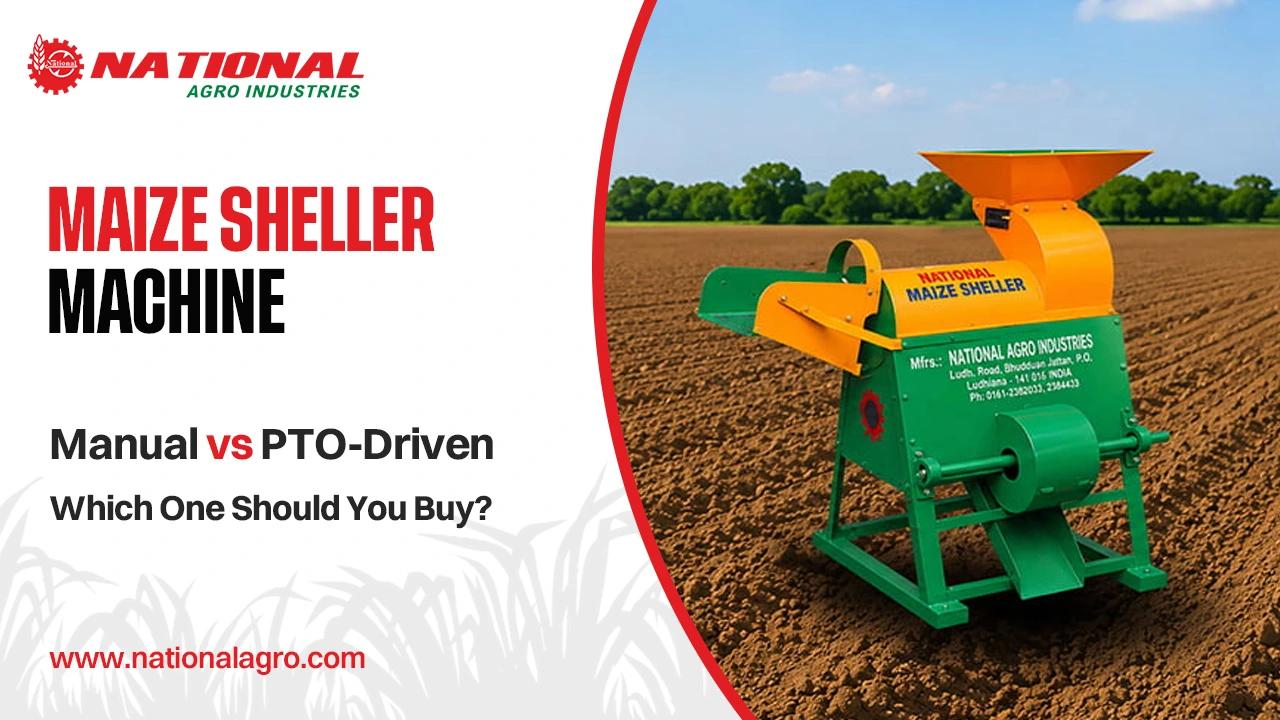
- Three-point linkage. Make sure the sheller mounts on your tractor's three-point linkage without awkward adjustments. Our National Maize Sheller is PTO-driven and comes with a three-point linkage.
- Output capacity. Ask for the rated capacity and how it was measured. A number without conditions, such as grain moisture or cob size, doesn't tell you much.
- Build quality. Look at the frame, welds, bearings, and paint. The National Maize Sheller uses heavy-duty construction, with components made on CNC machines and MIG welded, and a surface treatment that ends in a PU top coat to protect against corrosion.
- Spare parts and support. A sheller works hard for a short season, so parts and service need to be available before the next harvest. Ask who supports the machine near you.
If you want help matching a machine to your tractor, you can contact the National Agro team with your tractor HP and the quantity of maize you handle.
How to Reduce Kernel Damage While Shelling
Some breakage happens with any sheller, but a few habits keep it down.
Watch the moisture. Agricultural engineering studies on small maize shellers keep coming back to grain moisture. In one study published in the Misr Journal of Agricultural Engineering, maize at about 12% moisture gave the best shelling results. A motorised sheller trial indexed by FAO's AGRIS database found damage went up as grain got wetter. Very wet grain shells poorly, and very dry grain can crack more easily, so avoid both extremes.
Respect drum speed. The same research points one way on speed. Faster cylinders shell quicker but break more kernels. On a PTO machine, run the tractor's PTO at the speed the manual recommends and don't over-rev it to save time.
Feed steadily. Dumping too many cobs in at once overloads the drum and hurts efficiency. A steady, even feed gives cleaner results.
Use dry, mature cobs. Cobs that are properly dried before shelling come off cleaner. Trial results vary by machine, so treat the figures above as a guide and check your sheller's manual for its own settings.
Maize Sheller Machine Price: What Affects the Cost?
Prices change by model, region, and season, so it is better to ask a dealer for a current quote. These are the factors that move the price:
- Type of drive. Hand-operated machines cost the least, and motor-driven and PTO-driven machines cost more.
- Capacity. Higher output usually means a bigger machine and a higher price.
- Build and materials. Frame thickness, quality of bearings and fasteners, and surface finish all affect cost and how long the machine lasts.
- Tractor compatibility. PTO models need to match your tractor's power and linkage.
- Spare parts and after-sales support. A machine backed by easy spares can be worth more over several seasons.
- Transport and local dealer charges. Delivery to your farm adds to the final figure.
It is also worth asking your local agriculture department whether any machinery subsidy applies in your state, since schemes and eligibility change from year to year.
FAQs
What is the difference between a maize sheller and a corn sheller?
There is no difference in how they work. Maize and corn are two names for the same crop, so a maize sheller and a corn sheller do the same job. The name you see usually depends on the country or region.
What HP tractor is needed for a maize sheller?
It depends on the model and its capacity. Ask the manufacturer for the power requirement before buying and check it against your tractor's PTO rating. You can share your tractor HP with the National Agro team and they will tell you if the machine suits it.
Does a sheller break the kernels?
Some breakage can happen with any sheller, including hand shelling. How much depends on grain moisture, drum speed, feed rate, and how well the machine is built and adjusted. Using dry, mature cobs at a sensible drum speed keeps damage low.
Is a manual sheller or a machine better for a small farmer?
For a small harvest, a manual sheller is usually enough and costs less. If your maize volume grows or labour gets expensive, sharing or hiring a power sheller is a good middle step before buying your own.
Quick recap
- Hand shelling is slow and tiring, and it can damage kernels.
- A maize sheller machine and a corn sheller machine are the same thing, and they strip kernels off dry cobs using a rotating drum.
- Manual shellers suit small plots. Motor-driven and PTO-driven models suit medium and large harvests.
- Before buying a PTO sheller, check tractor HP, three-point linkage, rated capacity, build quality, and spare parts.
- Keep grain moisture moderate and drum speed sensible to cut down kernel breakage.
Ready to talk to someone about the right machine for your farm? Visit the National Maize Sheller page or get in touch with our team.


QR Code