
- Home
- About Us
-
Products
- National Zero Till Seed Cum
Ferti Drill - National Zero Till Happy Seeder
- National Zero Till Multi Crop
Planter for 2 Wheel Tractor
(Direct Hitch/Power Tiller) - National Direct Seeder for
Rice (Multi Crop) - National Seed Cum Fertilizer Drill
- National Multi Crop Planter
- National Multi Crop Planter for
Mini Power Tiller - National Multi Crop Ridge Planter
- National Raised Bed Planter
- National Pneumatic Planter
- National Fertilizer Spreader
- National Vegitable Nursery
Transplanter - National Axil Flow Vegetable
Seed Extractor - National Grond Nut Digger
- National Post Hole Digger
- National Maize Sheller
No-Tillage Equipment
Tillage Equipment
Ridge Planter Equipment
Bed Planter Equipment
Precision Planter Equipment
Fertilizer & Nursery Equipment
Specialized Seed Extractors
& Vegetable Equipme
Urea Deep Placement
- National Zero Till Seed Cum
- Blogs
- Awards
- Career
- Gallery
Contact Us
Become a Dealer
Become a Vendor
What Is a Seed Drill? Types, Uses & Price Guide (2026)
02, October, 2026
What Is a Seed Drill? Types, Uses & Price Guide (2026)
My uncle still swears by the old ways, but watching him chase a flock of pigeons off his freshly broadcast wheat field three years ago told me everything I needed to know. Half his seed budget went straight into the bellies of local birds. The rest sprouted in weird, crowded clumps that choked each other out by mid-season.
Broadcast sowing is a gamble. It always has been. And frankly, that frustrating uncertainty is why the humble seed drill is still the most reliable piece of kit you can hitch to your tractor. If you want a crop that comes up thick and even without wasting half your bag of seed, you need a way to get it into the dirt at the right depth every single time.
Here is the no-nonsense breakdown of how seed drills work, what they actually cost, and how to pick one that won't give out on you halfway through sowing season.
What Is a Seed Drill, in Plain Terms
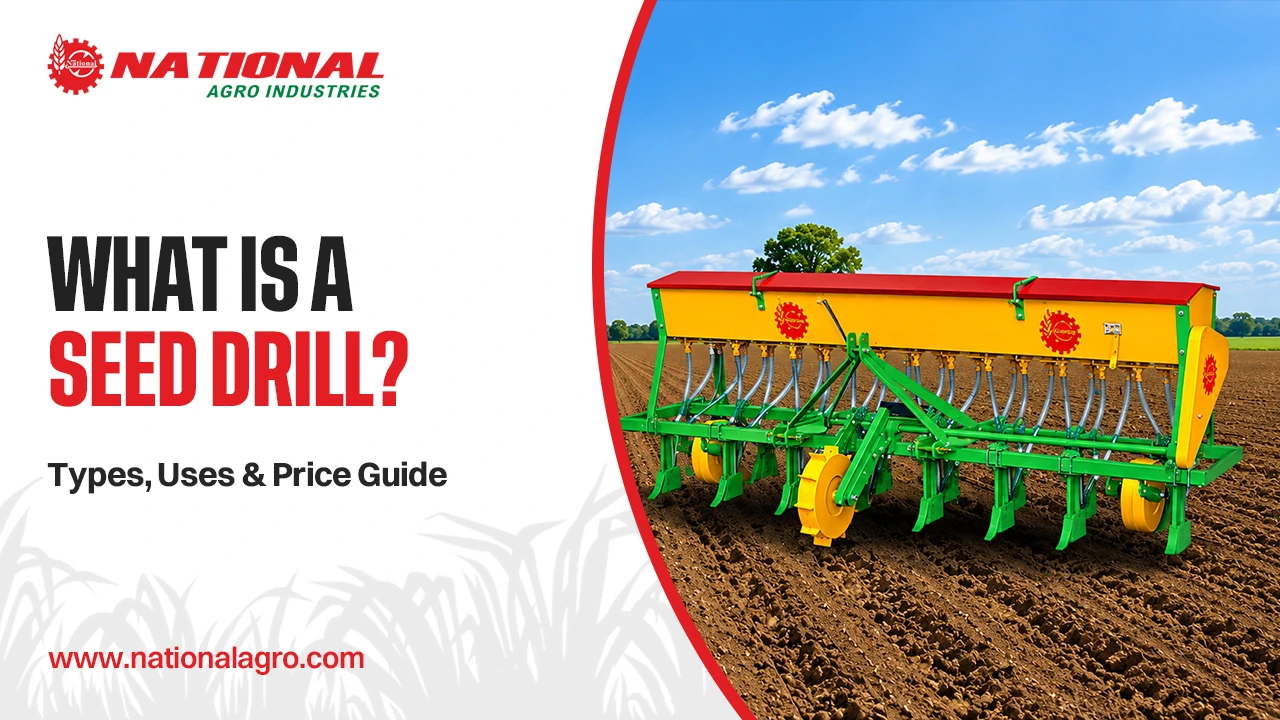
A seed drill is just a tractor-drawn implement that carves narrow trenches in the dirt, drops seeds inside at a set rate, and buries them right away.
Instead of scattering seed over top of the soil and hoping for rain, a drill lines everything up in neat, parallel rows. It sets the seed deep enough to hold onto soil moisture while keeping it safe from birds, hot sun, and heavy winds. The result is simple: better germination, stronger roots, and way higher yields come harvest time.
How a Seed Drill Actually Works
Without the paint and labels, each seed drill uses the same three fundamental mechanical processes working together:
- Groove preparation: Steel tines or rotating discs cut through the hard soil surface to create an empty groove at a predetermined depth.
- Sowing: The seed is contained in a long box known as a hopper which sits on top of the framework of the drill. Rotating fluted rollers are spun by the wheels on the ground and the flutes deliver the seed via rubber tubes into the groove.
- Trench cover: Dragging chains or rubber press wheels follow behind to push the soil back over the seeds and press it into direct contact with wet soil.
Types of Seed Drills
Not every soil type responds to the same treatment. Depending on how much field prep you plan on doing before sowing, you will usually end up looking at three main styles:
|
Seed Drill Type |
Key Characteristics |
Best Suited For |
|
Conventional Seed Drill |
Basic seed box and tines; needs a thoroughly plowed, fine seedbed. |
Clean, fully tilled fields with no leftover crop stubble. |
|
Seed-cum-Fertilizer Drill |
Two separate compartments to drop fertilizer and seed at the same time without burning the seed. |
Farmers looking to save fuel and labor by combining sowing and fertilizing into one pass. |
|
Zero-Till Ferti Seed Drill |
Heavy inverted-T tines or sharp discs that cut right through standing stubble and unplowed dirt. |
Direct sowing into paddy stubble, saving soil moisture, and skipping heavy land prep. |
What Crops a Seed Drill Is Used For
Seed drills are built for crops that need continuous, high-density row planting. If you are growing small grains or oilseeds, this is your primary tool.
- Grains & Cereals: Wheat, barley, oats, and direct-seeded rice (DSR).
- Pulses & Legumes: Chickpeas (chana), lentils, field peas, moong.
- Oilseeds: Mustard, raya, canola, sesame.
- Fodder: Lucerne, berseem, clover.
Because a drill streams seed out continuously along a line, it works best for crops that don't need careful individual plant-to-plant spacing.
Seed Drill Machine Price in India — What Affects the Cost
In India, a standard tractor-operated seed drill will cost anywhere between ₹35,000 and ₹2,500,000, depending on how wide it is, the steel quality, and whether it handles fertilizer too.
- Basic 9-Tine Conventional Model: ₹35,000 to ₹60,000
- 11 to 13 Tine Seed-cum-Fertilizer Drill: ₹65,000 to ₹1,10,000
- Heavy-Duty Zero-Till / Super Seeder Units: ₹1,20,000 to ₹2,50,000+
What Drives Up the Price?
- Tine Count: A small 9-tine machine takes less steel and less horsepower, whereas a 13 or 15-tine rig needs a heavier frame and a stronger tractor to pull it.
- Dual Hoppers: Adding a separate compartment with non-corrosive gearboxes for chemical fertilizer adds cost upfront, but saves you a second trip across the field later.
- Build Quality: Cheap metal tines bend the moment they hit a hidden stone or dry hardpan. High-carbon steel tines and reinforced frame tubes cost more, but they won't warp on you mid-season.
- Subsidies: Don't forget to check local agricultural schemes (like SMAM). State subsidies often cover 40% to 50% of the cost for eligible farmers, which takes a huge bite out of that retail tag.
Seed Drill vs Planter — Are They the Same Thing?
People mix these two up constantly, but they do entirely different jobs in the field.
- Seed Drill: Distributes seeds in a constant stream down the furrow. It regulates the amount of weight of the seeds planted per acre but not the distance between seeds. Ideal for planting small crops such as wheat and mustard crops that grow in a dense arrangement.
- Planter (Precision Planter): Picks up single seeds from the hopper through rotating vacuum discs or mechanical fingers. Seeds are distributed in an exact and uniform manner. Best suited for bold or widely spaced row crops such as corn, cotton, sunflower, and soybeans.
FAQs
What is the primary function of a seed drill?
It helps plant seeds in straight lines with consistent spacing and at an even depth, ensuring the seeds have proper coverage with soil to prevent consumption by birds and proper hydration for germination.
What is the definition of a "seed drill" in agriculture?
It is any mechanical apparatus pulled by a tractor or by animals which automatically plants seeds by cutting a furrow, planting the seeds at a controlled pace, and then covering them.
Is a seed drill the same as a planter?
No. A seed drill drops seeds continuously down a line (ideal for wheat and grains), while a planter places single seeds at precise distances from one another (ideal for corn and cotton).
Already own a seed drill and want to make sure your calibration isn't wasting seed? Check out our complete guide to using a seed drill correctly.
If you are looking to upgrade your setup before the next sowing window, take a look at the heavy-duty National Seed Cum Fertilizer Drill or check out the National Zero Till Ferti Seed Drill to find a model sized right for your tractor.


QR Code